CVE-2024-27300: Phpmyfaq/phpmyfaq Cross-Site Scripting Vulnerability
MODERATECVE-2024-27300 is a MODERATE (CVSS 5.5) cross-site scripting vulnerability (CWE-79: Improper Neutralization of Input During Web Page Generation ('Cross-site Scripting')) affecting Phpmyfaq/phpmyfaq libraries in the Packagist ecosystem. The issue involves phpmyfaq stored cross-site scripting at user email. Remediation is available by upgrading affected packages to version 3.2.6.
CVE-2024-27300 at a Glance
Security Impact
CVSS: 5.5
The security impact metrics below are parsed directly from the CVSS v3.1 vector string (CVSS:3.1/AV:N/AC:L/PR:L/UI:R/S:U/C:L/I:L/A:L).
How to Fix CVE-2024-27300
To remediate this vulnerability, upgrade all affected Phpmyfaq/phpmyfaq dependencies to a patched release. Both direct and transitive dependencies should be checked, as frameworks or security libraries may pull in vulnerable versions transitively.
Upgrade phpmyfaq/phpmyfaq to 3.2.6Run the following command in your project directory to verify that all resolved dependencies use the patched release:
inspect dependencies for phpmyfaq/phpmyfaqHow to Check if You Are Affected
To determine whether your application is affected by CVE-2024-27300, inspect your project dependencies for Phpmyfaq/phpmyfaq:
inspect dependencies for phpmyfaq/phpmyfaqAnalyze the terminal output to locate any version of Phpmyfaq/phpmyfaq in your dependency tree. If any resolved version matches the vulnerable ranges listed in the table below (for example, versions earlier than 3.2.6), your application is affected.
Note: Verify declared build manifests and deployed runtime container environments.
Technical Details
Vulnerability Mechanism & Technical Analysis
This vulnerability is classified under CWE-79: Improper Neutralization of Input During Web Page Generation ('Cross-site Scripting'), where the product does not neutralize or incorrectly neutralizes user-controllable input before it is placed in output that is used as a web page that is served to other users. In Phpmyfaq/phpmyfaq, software state validation or input boundaries are circumvented during processing. Review the official source advisory statement below for specific affected components, classes, and reproduction details.
Source Advisory Statement
CVE-2024-27300 Affected Phpmyfaq/phpmyfaq Versions
1 component(s)| Product / Package | Ecosystem | Affected Versions | Fixed Version |
|---|---|---|---|
|
phpmyfaq/phpmyfaq
|
Packagist |
≥ 3.2.5
< 3.2.6
All 1 versions
3.2.5
|
3.2.6
|
References
Frequently Asked Questions
What is CVE-2024-27300?
Which Phpmyfaq/phpmyfaq versions are affected?
What version fixes CVE-2024-27300?
Is phpmyfaq/phpmyfaq affected?
What is the CVSS score of CVE-2024-27300?
What CWE is associated with CVE-2024-27300?
How can I check Packagist dependencies for CVE-2024-27300?
Machine-readable OSV JSON
OSV v1.5 Schema
{
"schema_version" : "1.4.0",
"id" : "GHSA-q7g6-xfh2-vhpx",
"modified" : "2024-03-25T22:28:21Z",
"published" : "2024-03-25T19:46:28Z",
"aliases" : [ "CVE-2024-27300" ],
"summary" : "phpMyFAQ stored Cross-site Scripting at user email",
"details" : "### Summary\nThe `email` field in phpMyFAQ's user control panel page is vulnerable to stored XSS attacks due to the inadequacy of PHP's `FILTER_VALIDATE_EMAIL` function, which only validates the email format, not its content. This vulnerability enables an attacker to execute arbitrary client-side JavaScript within the context of another user's phpMyFAQ session.\n\n### Details\nDespite using PHP's `FILTER_VALIDATE_EMAIL` function, the email field does not adequately validate the content of the email address. This means that malicious input, such as JavaScript code, can be accepted and stored in the database without being detected. When the stored data is retrieved and displayed on web pages, it is not properly sanitized to remove or neutralize any potentially harmful content, such as JavaScript code which leads to Stored XSS.\n\n### PoC\n1. Login as any user, go to the user control panel, change email to any valid email and intercept the request.\n\n2. Modify the request’s email parameter to the following payload: `\"><svg/onload=confirm('XSS')>\"@x.y`\n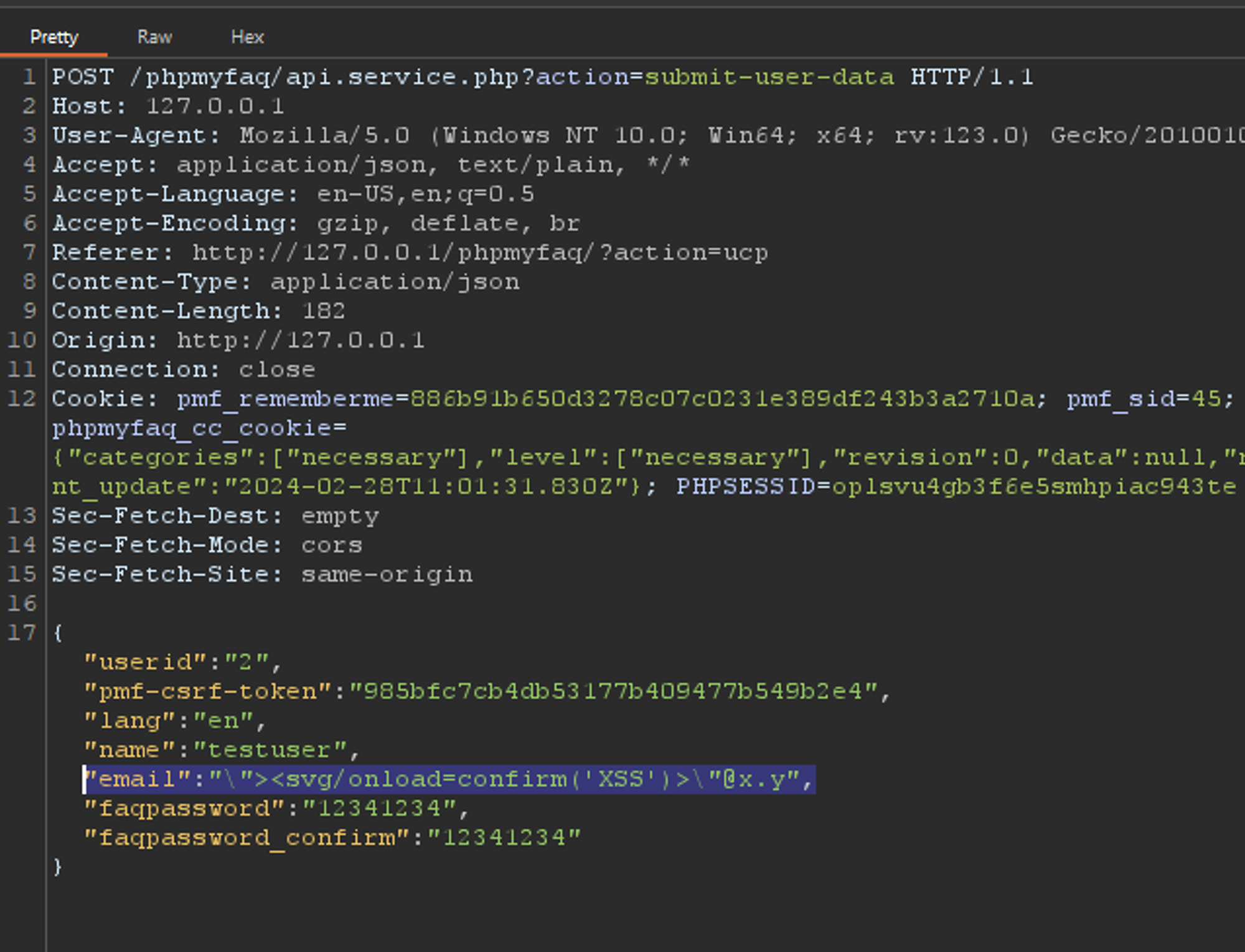\n\n\n3. Send the request and see that the XSS is triggered in the user control panel page.\n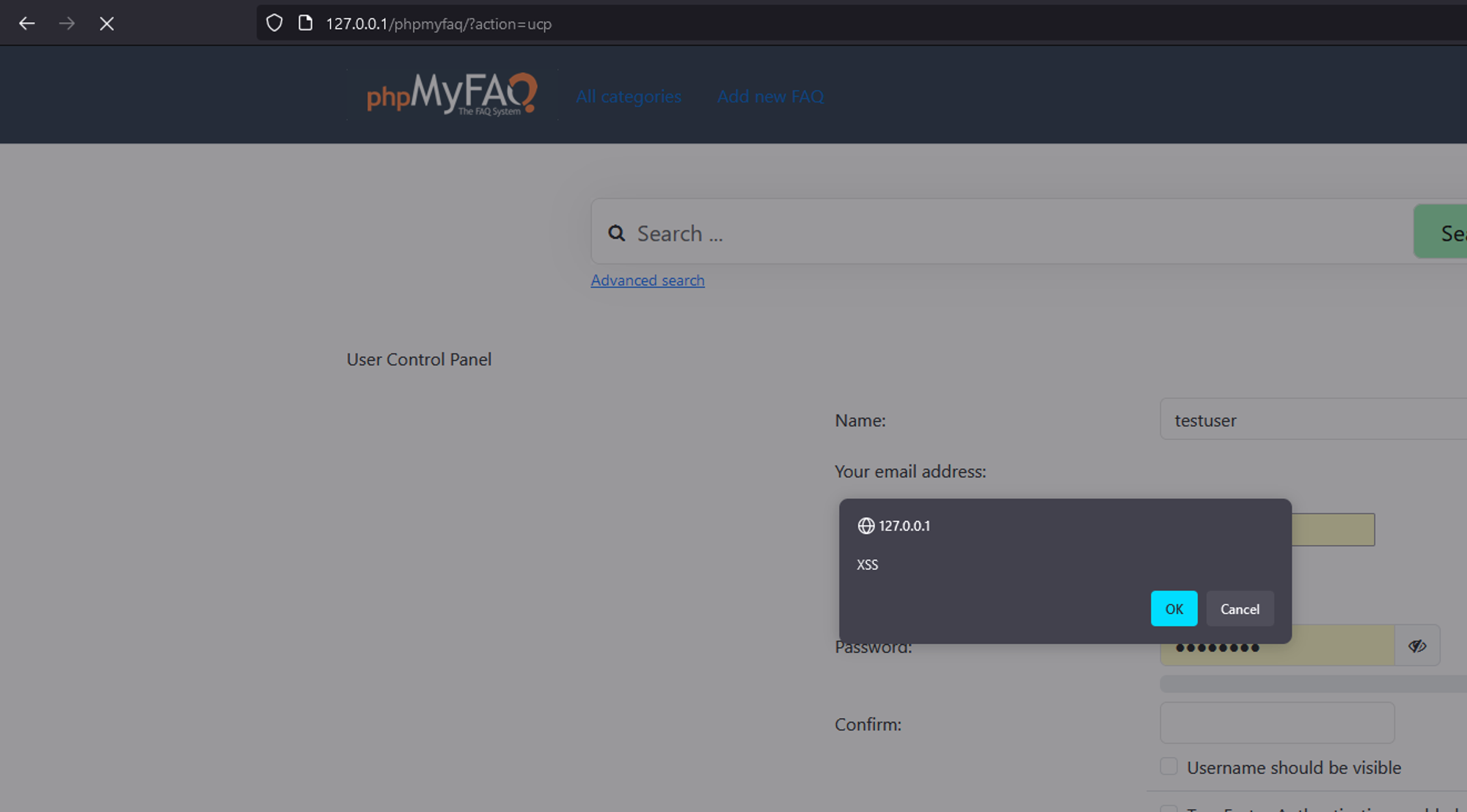\n\n\n4. Also affects any user who browse to \"../admin/?action=user&user_action=listallusers\"\n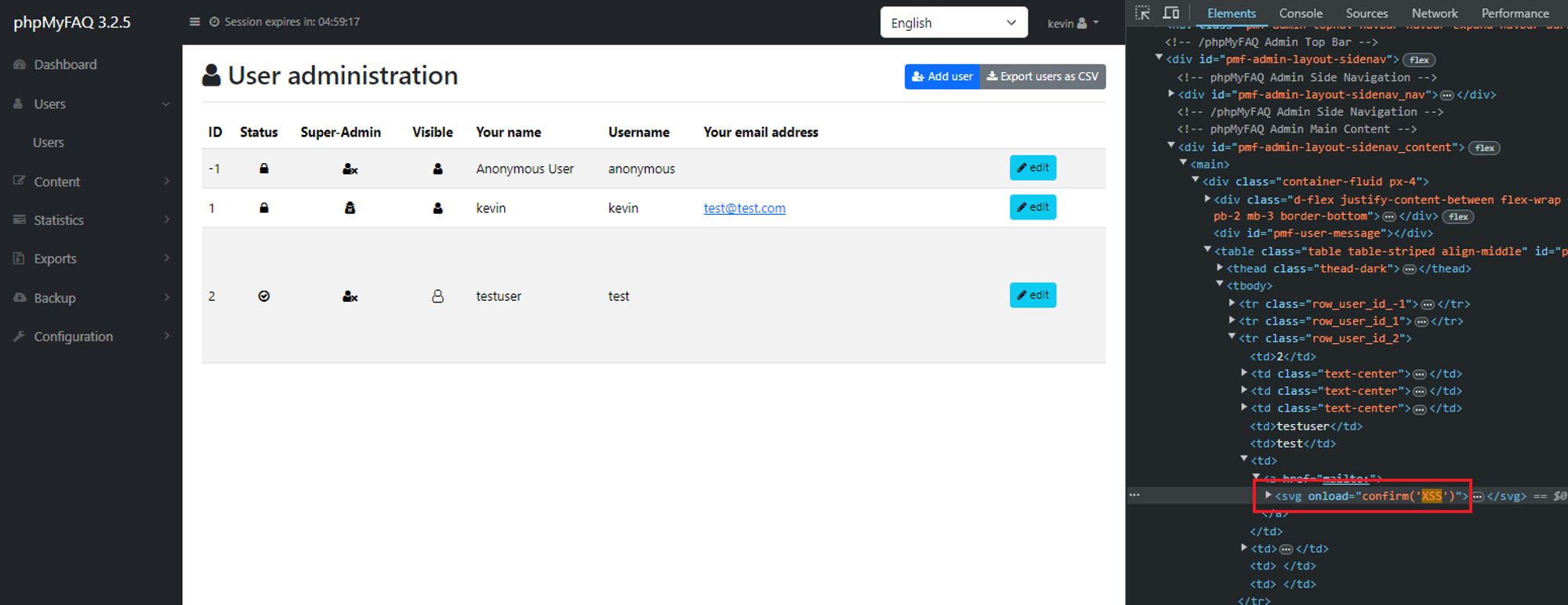\n\n\n### Impact\nThis allows an attacker to execute arbitrary client side JavaScript within the context of another user's phpMyFAQ session.\n",
"severity" : [ {
"type" : "CVSS_V3",
"score" : "CVSS:3.1/AV:N/AC:L/PR:L/UI:R/S:U/C:L/I:L/A:L"
} ],
"affected" : [ {
"package" : {
"ecosystem" : "Packagist",
"name" : "phpmyfaq/phpmyfaq"
},
"ranges" : [ {
"type" : "ECOSYSTEM",
"events" : [ {
"introduced" : "3.2.5"
}, {
"fixed" : "3.2.6"
} ]
} ],
"versions" : [ "3.2.5" ]
} ],
"references" : [ {
"type" : "WEB",
"url" : "https://github.com/thorsten/phpMyFAQ/security/advisories/GHSA-q7g6-xfh2-vhpx"
}, {
"type" : "ADVISORY",
"url" : "https://nvd.nist.gov/vuln/detail/CVE-2024-27300"
}, {
"type" : "WEB",
"url" : "https://github.com/thorsten/phpMyFAQ/commit/09336b0ff0e0a04aa0c97c5975651af4769d2459"
}, {
"type" : "WEB",
"url" : "https://github.com/thorsten/phpMyFAQ/commit/de90315c9bd4ead5fe6ba5586f6b016843aa8209"
}, {
"type" : "PACKAGE",
"url" : "https://github.com/thorsten/phpMyFAQ"
} ],
"database_specific" : {
"cwe_ids" : [ "CWE-79" ],
"severity" : "MODERATE",
"github_reviewed" : true,
"github_reviewed_at" : "2024-03-25T19:46:28Z",
"nvd_published_at" : "2024-03-25T19:15:57Z"
}
}